September 30, 2009

The Forthcoming Revised English Translation of the "Missale Romanum" and Its Implications for Worship

by Rev. Paul Turner, B.A., M.Div., M.A., Th.D. USA.


Paul Turner is a facilitator for the International Commission on English in the Liturgy, a past President of the North American Academy of Liturgy, and is currently pastor of St. Munchin parish in Cameron, MO. He holds a doctorate in sacred theology from Sant' Anselmo in Rome and is the author of numerous books and resources, including, Celebrating Initiation: A Guide For Priests (World Library Publications, 2008), When Other Christians Become Catholic (Liturgical Press, 2007), Let Us Pray: A Guide to the Rubrics of Sunday Mass (Liturgical Press, 2006), and The Hallelujah Highway: A History of the Catechumenate (LTP, 2000).

October 21, 2009

Ravenna’s Baptisteries and their Mosaics

by Claudia Dobrinski, Universität Paderborn, Germany


This paper addresses the building history of the Neonian (Orthodox) Baptistery in Ravenna focusing upon its internal decoration, chiefly mosaics, and incrustations. In this analysis, new dates for the different building phases are put forth. Secondly, this orthodox baptistery will be compared to the Arian one, with particular reference to the mosaic of the Apostles’ at the cupola in both of them and their different interpretations.


November 18, 2009

Evil Spirits and Queer Psyche. Spiritual Intervention and Spiritual Equilibrium in Conflict 

by Pamela Klassen, Associate Professor, Department and Centre for the Study of Religion, BA, MA, PhD.


Arguing for a robust supernaturalism among liberal Protestants, Pamela Klassen traces a history of ritual experimentation among Anglican, Methodist, and United Church of Canada communities. Focusing particularly on rituals concerned with healing, broadly conceived, Klassen examines how liberal Protestants reconceived themselves and their religious others through experimenting with ritual practices drawn from Christian and non-Christian traditions and technological innovations. Her paper will be based on her forthcoming book, Healing Christians: Liberal Protestants and Pathologies of Modernity. For more information, see http://individual.utoronto.ca/pklassen

Wednesday, March 25, 3:15-4:14 pm

The Dominican Rite: Liturgy Reflecting Spirituality
by Rev. Marcos Ramos, O.P., B.A., M.A., MDiv, ThM, PhD. student (St. Michael’s College)


The Order of Preachers (Dominican Order) used before the changes of the Second Vatican Council its proper rite, created in order to help the friars celebrate their liturgy using elements of the Dominican tradition and spirituality. This paper will provide an overview of this Dominican Rite and how it reflects the historical and liturgical tradition that is essential to the order founded in the thirteenth century by Dominic of Guzman.

Wednesday, January 21, 2009 3:30-4:30 pm

Source and Summit of Spiritual Life: Foundations of the writings of Sts. John of the Cross and Teresa of Avila in the Church’s Eucharistic Liturgy
by Rev. Steve Wlusek, B.A., M.Div., M.A., Th.D. cand. (St. Michael’s College)

A parallel can be recognized between the liturgical actions of the Church’s celebration of the Eucharist and the key elements of the spiritual itinerary proposed by Carmelite mystics John of the Cross and Teresa of Avila. The emphasis that Teresa and John place upon the necessary elements of the spiritual journey, the sense of structure or order that is inherent within the soul’s path towards union with God, and the progression or movement from one spiritual plane to another reveal a close connection between the spiritual theology they present and the Church’s Eucharistic theology as expressed through its liturgical rites. This presentation will demonstrate that the spiritual theology of Sts. John of the Cross and Teresa of Avila is founded upon principles underlying the Church’s Eucharistic liturgy, and will underscore the correlation between the spiritual journey of the worshiping community and that of individual believers.

Wednesday, February 4, 2009 3:15-4:15 pm

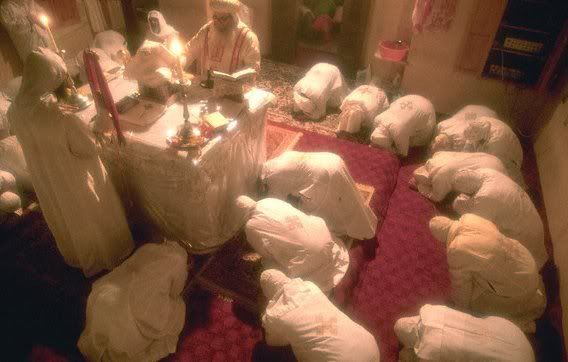
The Primitive Egyptian Eucharist
by Bishoy Dawood, B.A., M.T.S., Th.D. student (St. Michael’s College)


In the twentieth century, many liturgical scholars studied the origins of the Christian liturgical rites, but the majority of these studies focused on how the words of the known Anaphora prayers were derived from earlier Jewish prayers. It is rare to find works that focus on the ritualistic actions of liturgical rites from a historical-developmental perspective. This presentation will focus on presenting a Eucharistic tradition that consists of ritualistic action and will argue that the Coptic rite of the “Offertory," which is still in use in the Coptic churches today and prayed before all the Anaphoras, is a primitive and complete Eucharistic rite.

Wednesday, March 4, 2009 3:15-4:15 pm

Exploring the Notion of Intercultural Worship
Rev. Teresa A. Burnett-Cole, B.A., M.Div., Th.D. cand. (Emmanuel College). Minister, Riverdale United Church, Toronto


Worship in the post-colonial age presents particular challenges. What are the theological imperatives behind intercultural worship? What are its possible guiding principles? What might such worship look like? This presentation will explore the challenges interculturalism presents in the field of liturgical theology and offers some possible ways forward in the dialogue.

Wednesday, October 1, 2008 3:15-4:15

The Orientation of Sacred Space and Liturgical Prayer. The Debate around the celebration versus populum in the Catholic Church
by David H. Pereyra, MArch. MA., PhD. cand. (St. Michael's College)

The placement of the altar and the orientation of president and assembly in the liturgical celebration have become again matter for a heated theological debate. While the liturgical reform that followed Vatican II prescribed the orientation versus populum, Joseph Ratzinger, even before becoming Pope Benedict XVI, called into question the reasons for this change.
The present paper explores both arguments for and against the orientation versus populum in contemporary liturgical debate.

Wednesday, November 5, 2008 3:15-4:15

Ta Hagia Tois Hagiois
("The Holy Things for the Holy People")
Eucharistic Rites in Late Fourth Century Jerusalem

by Prof. Pablo Argárate, Dr. phil., Dr. theol. (Tübingen) (St. Michael’s College)

With Helena's discoveries, the "Holy Places" emerge in the fourth century, and a broad culture of pilgrimage develops. In the meantime, through stations and processions the liturgy begins appropriating these places, and by doing this, transforming them into "sacred space." The pilgrims, returning to their lands, brought back alongside with their intense spiritual experience the liturgical practices of the Holy City as well.
The lecture discusses the Eucharistic rites in Jerusalem in the witness of the bishop Cyril.

Wednesday, December 3, 2008 3:15-4:15

Liturgical Reform in Contemporary Judaism: 
Is it Necessary? Does it Work?
by Rabbi Dow Marmur, PhD (Senior Rabbi of Holy Blossom, Toronto)

In line with Heinrich Heine's dictum that "Jews pray theology," non-Orthodox movements in Judaism, particularly Reform, have tended to adjust the traditional liturgy to fit their theological orientation. As a result, new prayer books have been created in different countries, often every 25 years or so - as the theologies have been revised.
This paper addresses the complex question on whether these noble and often creative efforts help people to pray, or if they are primarily the result of eager editors and hopeful promoters.

Wednesday, January 16, 2008 3:00-4:00

Church Building in Quebec. The Secular Uses
by Richard Gauthier, PhD. (Trinity College)


As the sociologist Peter Berger wrote, Quebec, the former "priest-ridden" province, is now among the most secularized societies in the Western hemisphere. The impact in Church Building is the increasing number of the secular uses. The author present the phenomenon and, at the end, he proposes some ideas for the future.

Wednesday, February 13, 2008 3:00-4:00

Restoration of the Jerusalem Temple in Medieval Christian Liturgy
by Prof. Jennifer Harris, PhD. (St. Michael’s College)


A number of rites in the medieval Church borrowed their meaning and gestures from the long-destroyed Jerusalem Temple. In this seminar, I examine three types of borrowing that pervade Christian liturgy in the High Middle Ages: the ordo for the dedication of a church (and its annual commemoration), the Maundy Thursday liturgy performed once a year at the Lateran, and weekly eucharistic rites. My focus is on the Roman rites of the twelfth and thirteenth centuries.

Wednesday, March 19, 2008 3:00-4:00

The Dialectic of Worship in The United Church of Canada
by Prof. William S. Kervin, ThD. (Emmanuel College)


Only recently has the history of worship in The United Church of Canada received significant scholarly attention. The methodological challenges of such study are challenging because its Reformed Protestant and “Free Church” roots render many text-based liturgical methodologies of limited use. This presentation (based on a chapter in a forthcoming history of the United Church) conceives the liturgical history of the United Church as an on-going dialectic in which the interplay of text and context results in a uniquely complex liturgical tradition. From the union of 1925 to the emerging postmodernity of the turn of the millennium, United Church worship has been both a reflection of, and window on, each era. Its major worship resources, liturgical patterns and conciliar politics reveals its liturgical life to be a context-specific tradition perpetually in the process of selective recovery and renewal.

Wednesday, October 10, 2007 3:00-4:00

The Tridentine Liturgy and Liturgical Reform: Critical Reflections on the Motu Proprio Summorum Pontificum
by Prof. Christian McConnell, PhD. (St. Michael’s College)


Benedict XVI’s Apostolic Letter Summorum Pontificum, promulgated July 7, 2007, gives new, wider provision for the celebration of the Roman liturgy according to the pre-Vatican-II (“Tridentine”) Missal of 1962 and other liturgical books. The liturgical reforms of 1970 remain the normative form of the Roman liturgy, but the side-by-side existence of the postconciliar liturgy and the “older use” raises more questions than answers about the nature of liturgical reform, legitimate liturgical diversity, liturgical accomodation of pastoral needs, and the operative ecclesiology expressed in the liturgy.

Wednesday, November 7, 2007

“Go Ye Therefore” and “This Do”: Towards a Revitalization of Evangelical Eucharistic Praxis
by Sean E. O’Leary, ThD (Emmanuel College)


Jesus Christ, at the close of Matthew’s gospel, is recorded as having charged his followers to “Go ye therefore into all the world and make disciples of all nations” (Mt. 28:18). Together with Mark’s “Go and preach the good news to every creature” (Mk. 16:15) the “Great Commission” is the primary tenet upon which the modern evangelical movement is founded, attested to by evangelicalism’s emphasis on tangible conversion experiences, frequently utilizing worship as a means to this end. However, the resulting discipleship and spirituality of such pragmatism are often disconnected from many of the riches of the historic Christian faith and its liturgical rites—specifically, in the context of this lecture, a theologically, biblically, and historically informed eucharistic praxis. What is one to make of the diminishing significance of the traditional sacraments in general, and the eucharist in particular, in evangelical worship? What is the status of Reformed eucharistic theology and praxis in contemporary evangelicalism? Does evangelicalism live up to its own criteria of the centrality of scripture on this question (i.e., the import of biblical texts traditionally associated with the institution of the eucharist and the praxis of table fellowship)? Evangelicalism’s own biblical hermeneutics and liturgical traditions demand a closer scrutiny of its eucharistic praxis.

December 5, 2007

The Beauty of the Ethiopian Qiddase (Eucharistic Liturgy)

by Mebratu K. Gebru, PhD Student (Emmanuel College)


As the Byzantine Orthodox Churches call it, the Divine Liturgy is “heaven on earth service.” This is very true for the Qiddase of the Ethiopian Orthodox Tewahedo Church. Having Jewish, Coptic and Syrian roots, the Ethiopian Qiddase has undergone various developments which contributed to the splendor and exuberant beauty demonstrated in its celebration. The numerous Eucharistic anaphorae are also one of the factors for the richness of the Ethiopian Qiddase, and each anaphora is worth of an intensive scholarly study. Focusing on the pattern and peculiarities of the celebration of Ethiopian Qiddase, and on the meaningful symbolism of some of the acts in the celebration, this paper tries to show the liturgical beauty of Ethiopian Qiddase.